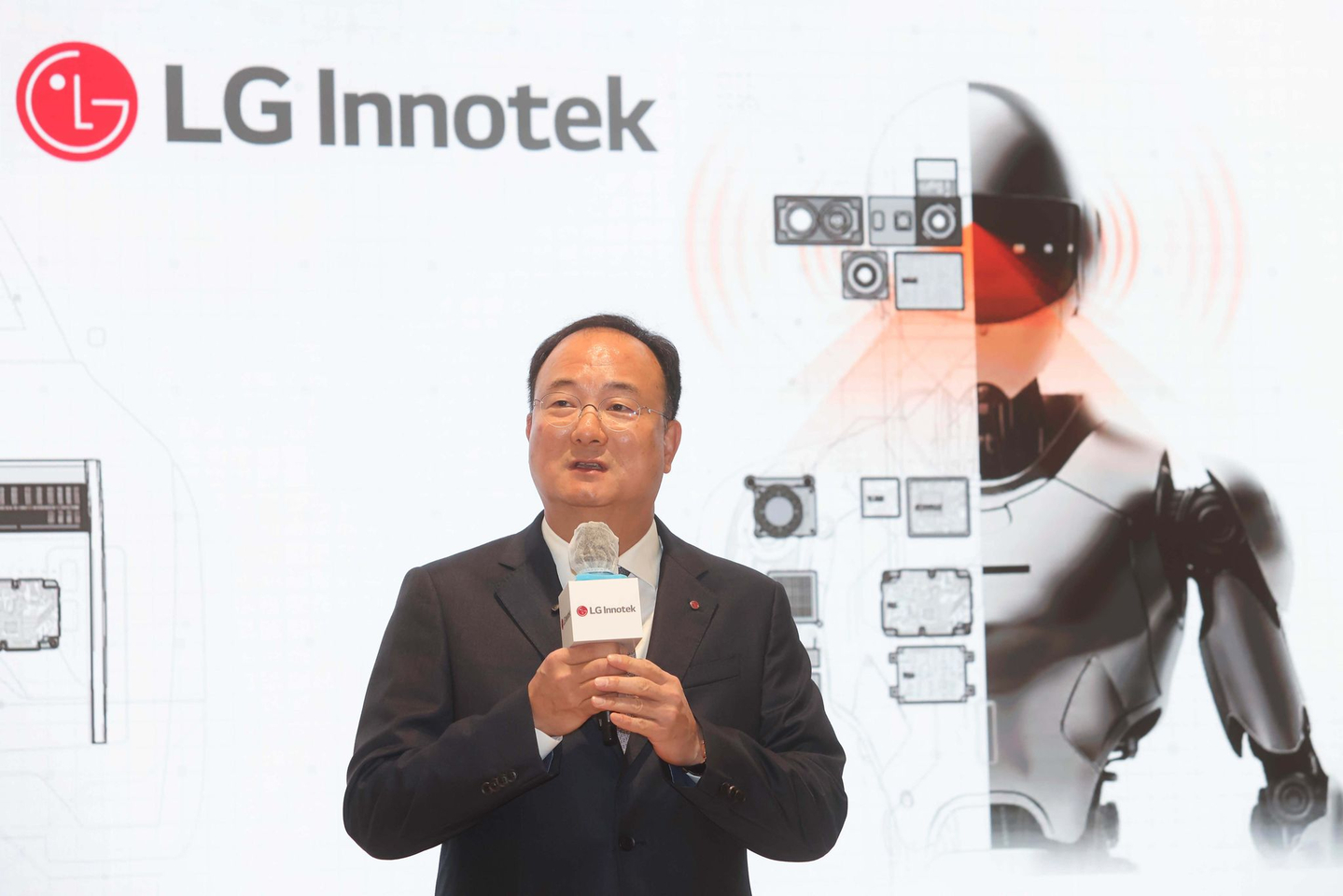
LG Innotek CEO Moon Hyuk-soo laid out aggressive growth targets for new businesses, reaffirming the company’s determination to reshape its business portfolio away from its heavy reliance on camera modules supplied for Apple’s iPhone.
“The semiconductor substrate business is currently running at full capacity because production capacity falls far short of customer demand,” Moon said Monday after the company’s annual shareholder meeting at LG Science Park in Magok, western Seoul. “We plan to decide on a site for a new plant within the first half of the year and double capacity.”
He also forecasted steep growth in the automotive electronics business. “Sales of automotive application processor modules will begin in earnest from the fourth quarter of this year,” he said. “At our Gwangju plant, we are producing composite modules that include high-bandwidth memory, and we are working to improve efficiency by combining them with sensors.”
Moon also expressed optimism about improved earnings this year.
“Operating profit in the first half of this year will rise sharply from a year earlier due to lower depreciation costs,” he said. As a strategy to secure profitability, he pointed to upgrading the business by combining hardware with software.
“We are moving away from a structure in which we simply supplied hardware, and recently we have been expanding our tier 1 supplier business by providing composite modules that include software,” Moon said. “Since there is a limit to cost reduction, we are shifting in a direction that raises business value.” He added that the company plans to soon disclose cooperation with major software firms.
![The LG Innotek booth is seen at the International Advanced Semiconductor Substrate & Packaging Industry Exhibition (KPCA Show 2025) in 2025. [LG INNOTEK]](https://www.newstheone.com/wp-content/uploads/2026/03/1774718897_313_LG이노텍-복합-모듈-사업-확장-계획.jpg)
Still, large-scale mass production of humanoid robot parts is expected to take more time. “We expect large-scale mass production of robot parts in 2027 or 2028,” Moon said. He added that robots are unlikely to generate meaningful revenue until around 2030.
The move is an attempt to accelerate its expansion into new fields because its business structure, which is heavily concentrated in a single area, has been cited as a weakness. Sales from the Optics Solution division, which includes camera modules, reached nearly 18.32 trillion won ($12.1 billion) in 2025, accounting for 83.6 percent of the company’s total revenue last year.
The semiconductor substrate business could be the relief pitcher. Annual sales from the Package Solution business, which includes substrates, rose 82 percent on year to 128.9 billion won in 2025, underscoring its growth momentum.
“A business model in which we develop parts on our own and then win bids from customers is losing competitiveness,” Moon said. “Based on the technologies we have built, we will transform ourselves into a company that provides optimal solutions.”
BY LEE YOUNG-KEUN [[email protected]]